ELISA Technique
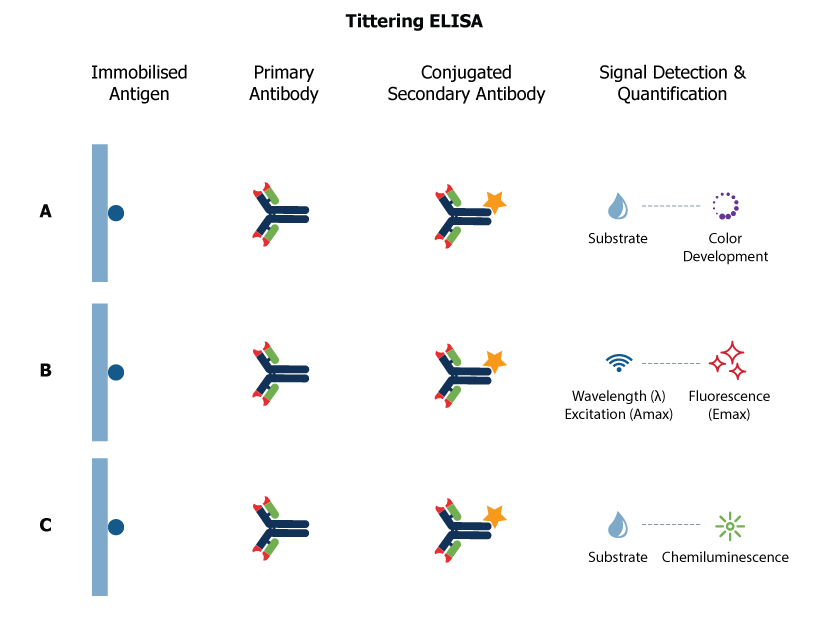
Enzyme-Linked Immunosorbent Assay (ELISA) is a common immunoassay, in which antibodies, peptides, proteins, and small molecules can be detected and quantified using a multi-well plate. This assay is the preferred method to determine the titer of antisera and purified antibodies. ELISA can also be successfully employed for the quantitative assessment of an antigen in a sample, often available in convenient, easy-to-use kit formats.
Key characteristics that make ELISA an ideal method of testing:
+
Versatile
Can be run in a variety of settings, with little equipment investment and many formats using different combinations of reagents.
+
Simple
Multiple samples can be tested in a single assay, providing high capacity, rapid, and inexpensive assays.
+
Sensitive
Readouts from enzyme catalysts or fluorescent tags efficiently amplify the signal and provide a broad range of sample detection.
+
Quantitative
The signal detected by multi-channel spectrophotometers allows data to be stored and analyzed statistically.
Although different immunoassay systems operate within common parameters, each configuration differs in the nature and number of stages needed. The common parameters include immobilization to a solid phase, separation of bound and free reagents by washing steps, and readout from colorimetric, fluorescent, or luminescent signals.
Rockland offers custom assay development services including qualification, validation, and lot release testing. Our ability to generate antibodies and supporting reagents within our own US-based facilities allows for efficiency and first-hand expertise throughout the assay development process.
ELISA Comparisons
| Direct | Indirect | Sandwich Direct | Sandwich Indirect | |
| Coating (adsorption to solid phase) | Antigen | Antigen | Capture antibody | Capture antibody |
| Blocking | Addition of blocking agent to prevent non-specific binding | |||
| Wash | Separate bound/unbound analytes | |||
| Analyte (addition of testing sample) | Enzyme- or fluorescence-conjugated antibody | Unconjugated antibody | Antigen sample | Antigen sample |
| Wash | Separate bound/unbound analytes | |||
| Secondary reagent | N/A | Enzyme- or fluorescence-conjugated antibody | Enzyme- or fluorescence-conjugated detection antibody | Biotin-conjugated or unconjugated detection antibody |
| Wash | Separate bound/unbound analytes | |||
| Additional reagent | N/A | N/A | N/A | Enzyme- or fluorescence-conjugated streptavidin or secondary antibody |
| Wash | Separate bound/unbound analytes | |||
| Signal development | Addition of substrate for enzyme-conjugated antibodies | |||
| Stop signal development | For end-point reading of enzyme-based detection systems | |||
| Signal Detection | Colorimetric, fluorescent, or chemiluminescent detection | |||
Types of ELISA
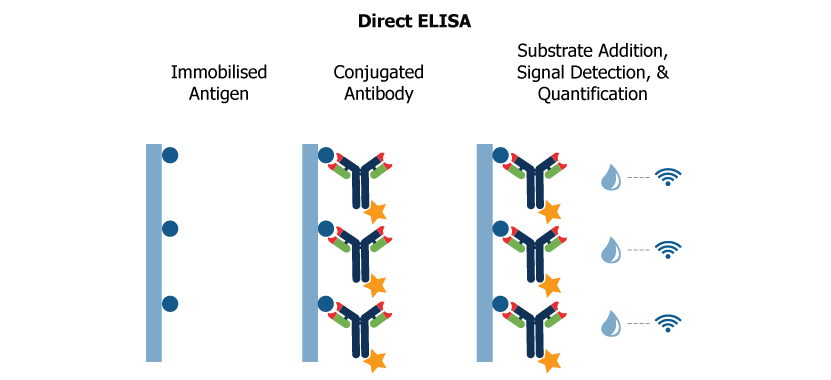
Direct ELISA
It is the simplest configuration in which the antigen is bound by passive adsorption to the solid phase, washed to remove any unbound molecules and then directly incubated with a conjugated antibody. Following the incubation period and additional washing, the substrate is added to produce a signal that is allowed to develop. After a certain time, the substrate reaction is stopped and the resulting signal quantified. It is commonly used for tittering conjugated secondary antibodies and is very useful to estimate antigen cross-reactivity.
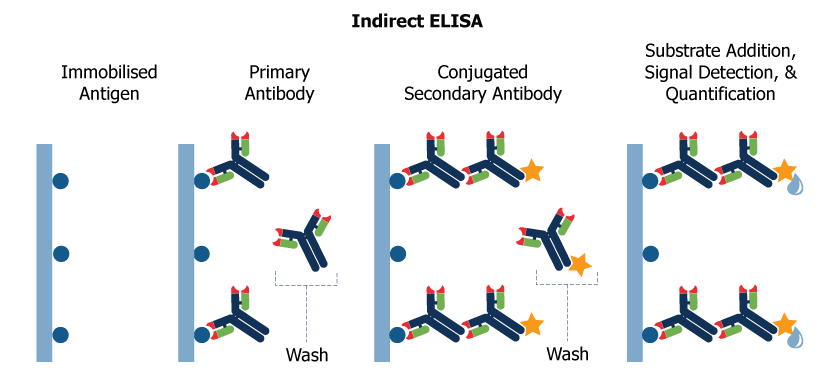
Indirect ELISA
In this system, initial antigen binding and washing steps are the same as the direct method. The main difference, in this case, is the use of an unconjugated antibody to bind the immobilized antigen upon incubation. Following a washing step to remove unbound antibodies, the remaining antigen-bound antibodies are targeted by a conjugated secondary antibody that will generate the readout signal as described for direct ELISA. This system allows multiple sample evaluations using different primary antibodies to be screened with a single conjugated secondary antibody.
Sandwich ELISA
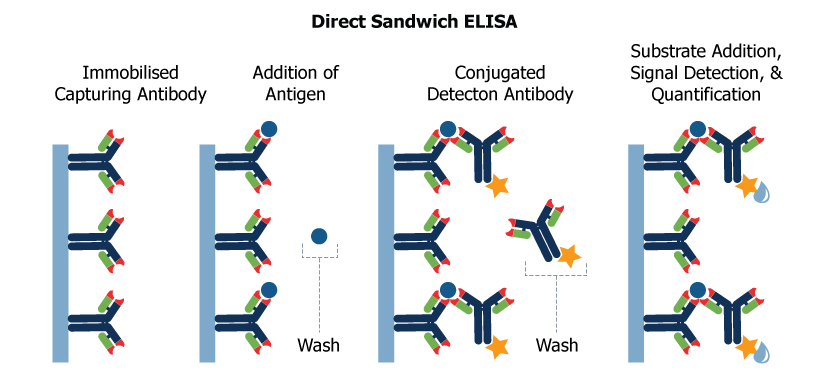
This assay requires a compatible antibody pair that recognize different antigenic targets (epitopes) on the same antigen. The first antibody, called the capture antibody, is coated on the plate and used to immobilize the antigen upon binding during incubation with the sample. Free antigen is removed by a washing step and then a detection antibody is added to bind the captured antigen and enable subsequent detection. Sandwich ELISA is divided into two main systems:
Direct Sandwich
Direct Sandwich uses a detection antibody conjugated to an enzyme or fluorescence tag. Following incubation with the antibody-antigen complex immobilized on the plate well, signal detection is performed upon successive addition of substrate and stopping solution or appropriate excitation/emission of the fluorescent tag.
Indirect Sandwich
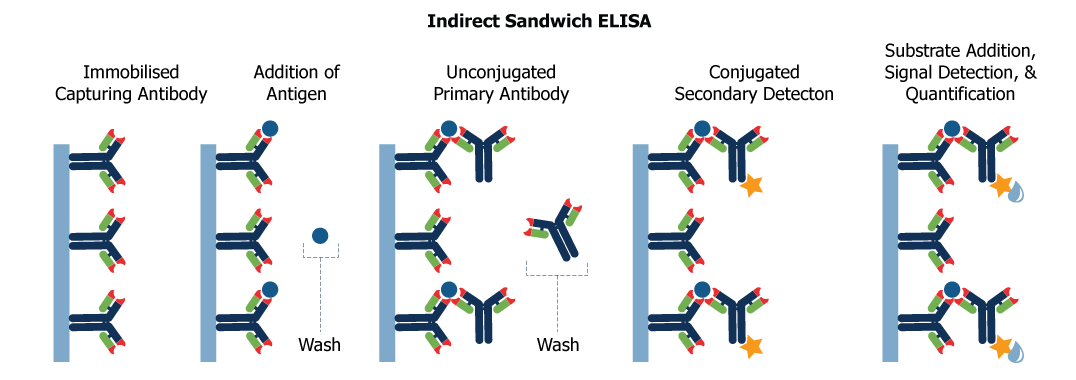
Indirect Sandwich uses an unconjugated antibody bound to the antibody-antigen complex on the well. Following a washing step to remove unbound antibodies, the remaining antigen-bound antibodies are targeted by a conjugated secondary detection antibody. Signal detection is performed upon successive addition of substrate and stopping solution or appropriate excitation/emission of the fluorescent tag.
Competitive and Inhibition ELISA
Each of the core systems described above can be further modified to measure molecules based on their ability to interfere with a well-known pre-titrated assay. Such assays can be used to study either antigens or antibodies and they can be competitive or inhibitory based on the specific conditions of each assay. In both types of assays, a pre-titrated system is challenged with the presence of the testing sample whose binding activity is then determined from the degree of the resulting interference in the established system.
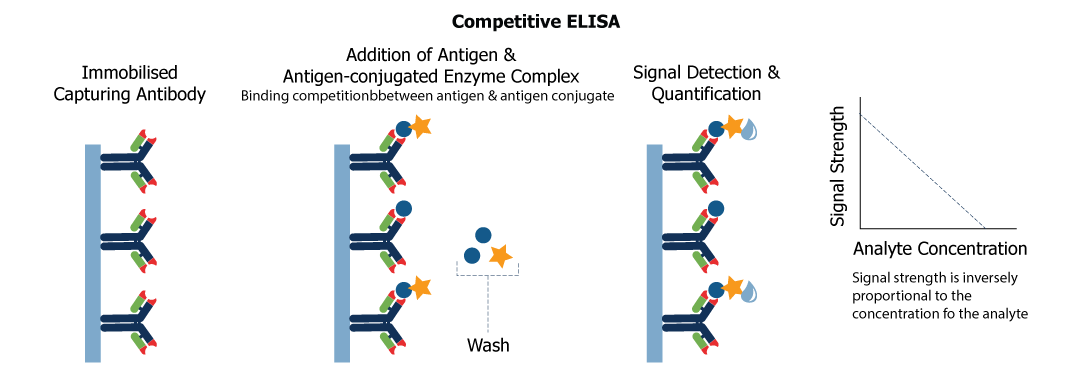
For the most part, inhibition assays give the testing sample the advantage of binding (i.e. incubated in advance) before the other system’s components are added whereas in competitive assays the testing sample is mix incubated and mixed with the other components of the pre-titrated system.